Probation, pretrial and parole officers shoulder one of the most demanding roles in the justice system. They supervise dozens, sometimes hundreds, of individuals balancing employment, treatment, housing instability, and court requirements. Every day requires careful coordination. Every alert demands attention.
A missed check-in triggers a follow-up. A curfew alert generates documentation. A boundary violation leads to calls, reports, and sometimes court appearances. Multiply those steps across a full caseload and the administrative burden grows quickly.
Many officers describe the same frustration: they entered the profession to guide behavioral change, yet much of their day revolves around processing minor technical violations. Instead of focusing on high-risk behavior or meaningful rehabilitation, they react to innocuous alerts. Non-compliance carries a cost that rarely appears in a budget line item. It drains officer time, increases court congestion, and can result in unnecessary detention for technical infractions that might have been corrected early.
Many supervision models still rely on disconnected systems. Location monitoring operates separately from chronological case notes. Officers are required to sign in and move between platforms to verify alerts, send messages, and document actions. That fragmentation slows response time and increases manual work and oftentimes, officers do not have the time to complete the proper documentation and/or verification.
Traditional ankle monitoring devices often notify officers after a boundary breach occurs, with little opportunity for the individual to correct behavior in real time. A client may step a few feet outside a geofence without malicious intent, but by the time the officer reviews the alert, the event has already escalated into a formal violation investigation.
Each minor violation requires review. Even a quick five- or ten-minute review compounds across hundreds of alerts per month, and with traditional ankle monitoring, many of these alerts are technical and not behavior-related. Officers spend hours verifying events that pose little threat to public safety. Unfortunately, this pattern pushes supervision into a reactive cycle where officers respond to technicalities instead of addressing higher risk supervision risks and needs to include employment setbacks, relapse warning signs, or housing instability. Over time, the workload shifts from coaching change to processing alerts.
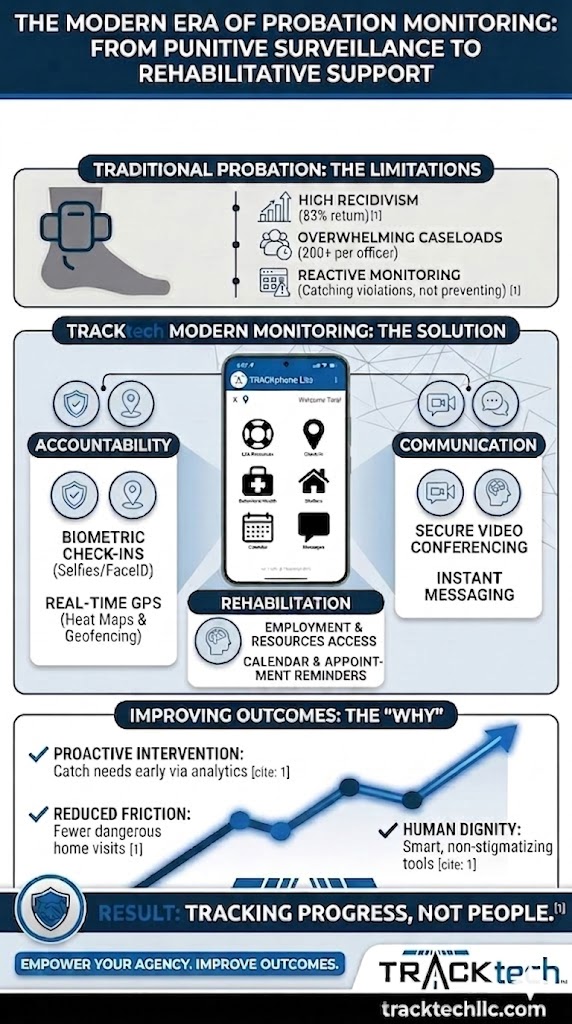
To understand how modern tools can reduce this burden, consider a clearly hypothetical example.
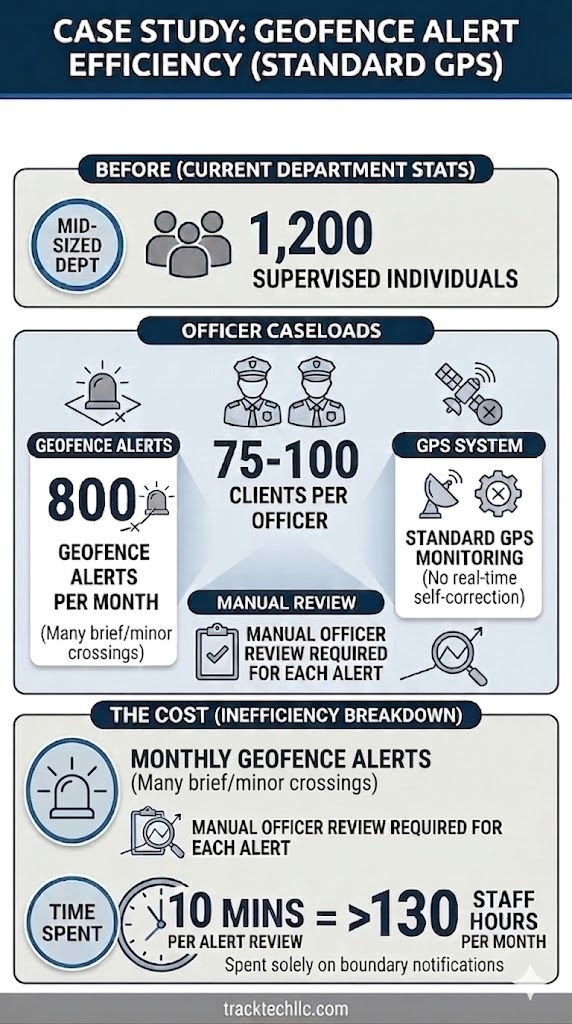
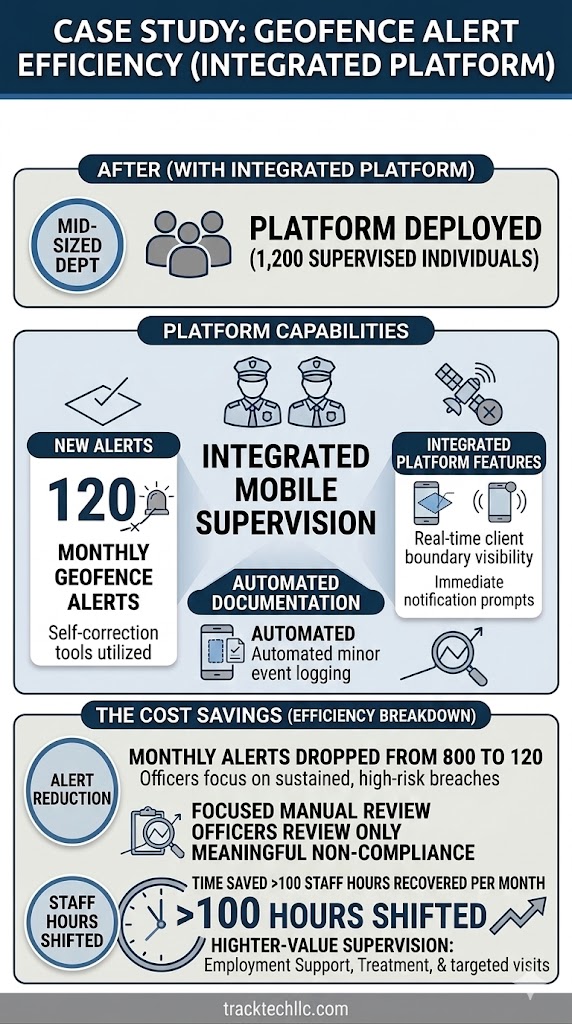
Picture a mid-sized probation department supervising 1,200 individuals. Officers manage caseloads ranging from 75 to 100 clients. The department relies on standard GPS monitoring without real-time self-correction functionality or tools. Each month, the system generates approximately 800 geofence alerts, many of which involve brief or minor boundary crossings that officers must review manually. If each alert requires just 10 minutes of review and documentation, that equals more than 130 staff hours per month spent solely on boundary notifications.
Now imagine that same department adopting an integrated mobile supervision platform with:
With clear visual boundaries and instant alerts delivered to the client, minor crossings decline and clients can adjust course immediately instead of learning about violations days later. This allows officers to configure alert thresholds to focus on sustained or high-risk breaches.
In this hypothetical scenario, monthly geofence alerts drop from 800 to 120. While officers still review meaningful violations and respond to non-compliance, they recover nearly 100 staff hours per month. Those hours shift toward higher-value supervision, like employment support, treatment coordination, targeted home visits, and structured check-ins designed to reduce risk factors.
Traditional systems often alert officers first and clients learn about violations after the fact. That delay fuels frustration and weakens accountability.
Self-correction functionality and tools change the sequence. When a client approaches a restricted zone, the device issues an immediate notification, giving the client an opportunity to step back within seconds and the system can log the event as resolved. The officer sees that the behavior corrected without escalation. This process reinforces cause and effect in real time, reduces unnecessary paperwork, and preserves court resources for serious violations. Officers retain authority and decide which alerts require intervention. They determine when behavior patterns signal greater risk. Technology filters noise so officers can focus on conduct that truly impacts public safety.
When supervision tools support communication, officers regain control of their schedules.
When supervision tools support communication, officers regain control of their schedules.
Secure mobile devices enable video check-ins that eliminate travel time, calendar reminders reduce missed appointments, and messaging features allow quick clarification before a misunderstanding becomes a violation. Video check-ins allow officer to achieve or obtain the same supervision information that would otherwise require extensive windshield time / driving, numerous manual phone calls, or failed attempts to reach the client.
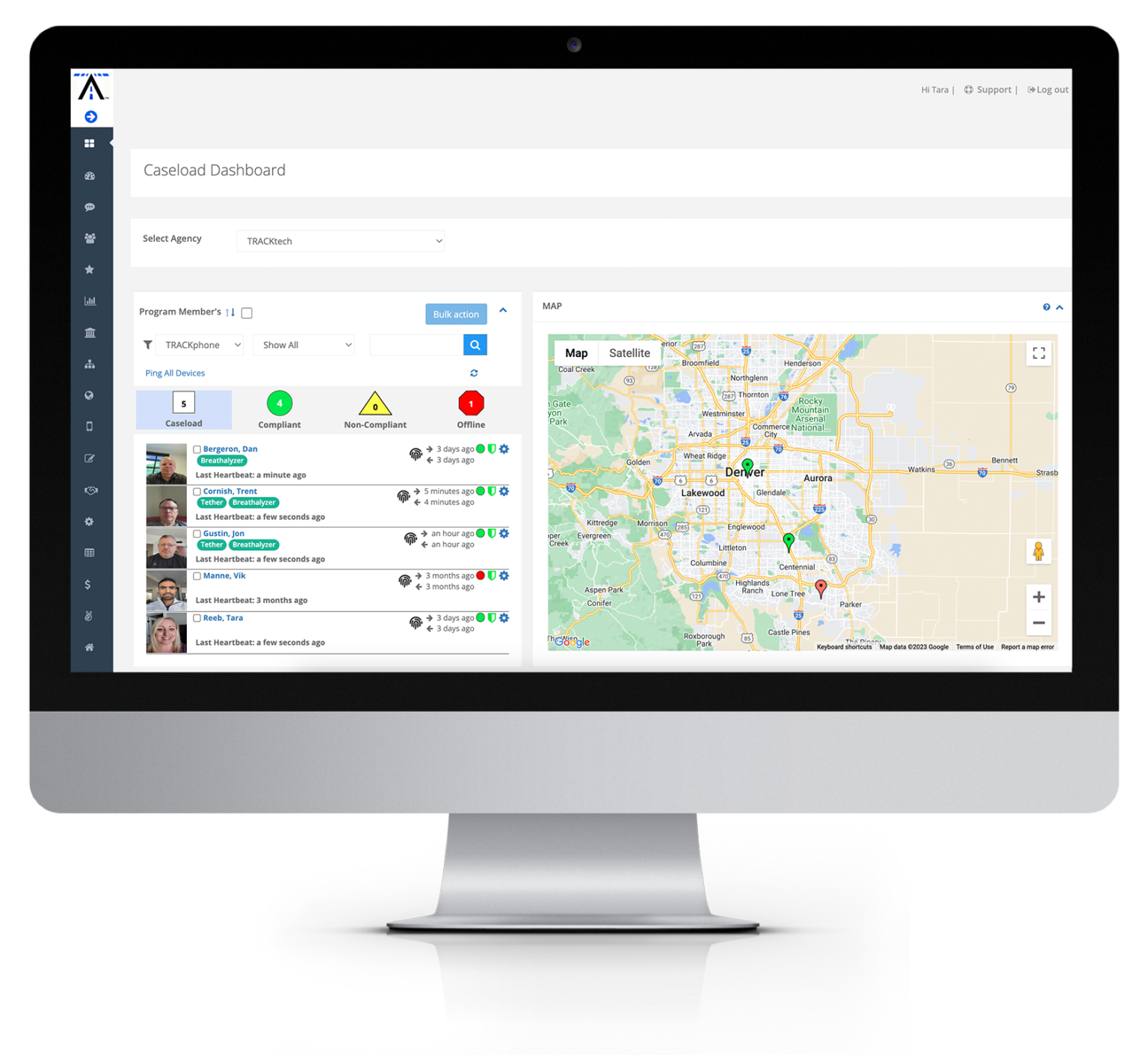
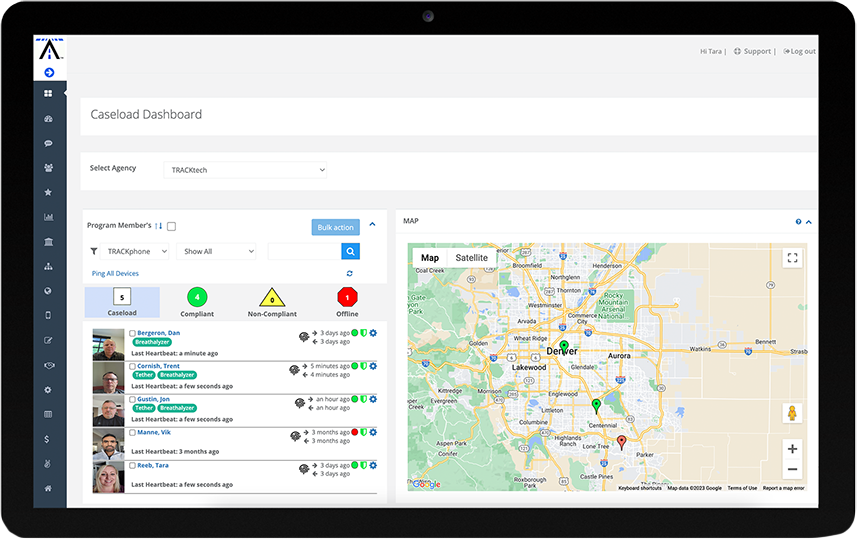
Centralized case management systems consolidate compliance data, communication logs, and workflow automation. This allows officers to configure check-ins, send appointment reminders, and review location data within one secure portal. TRACKtech built its platform around these operational realities.
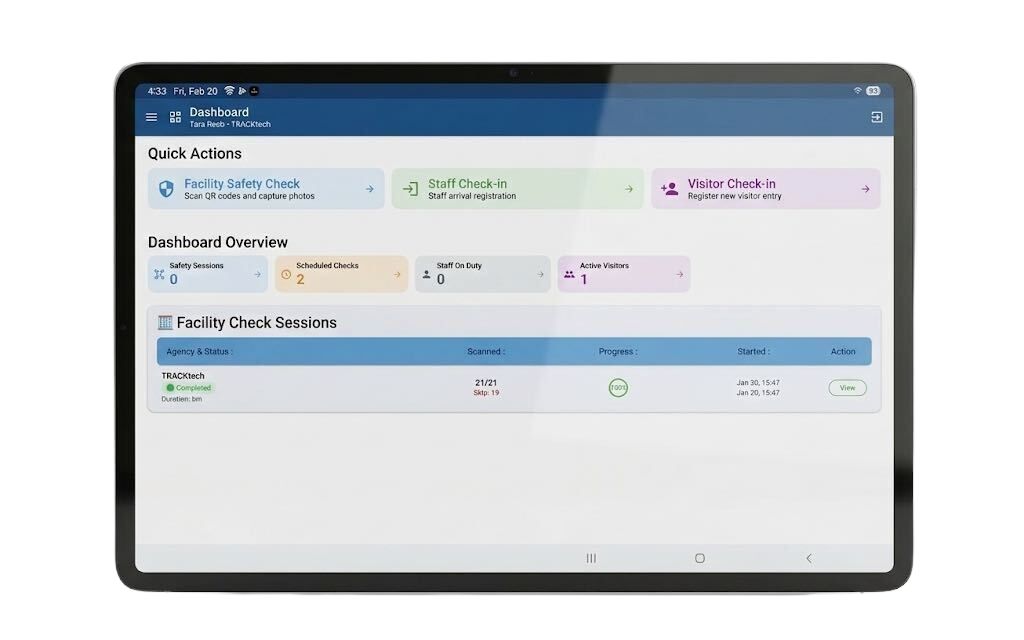
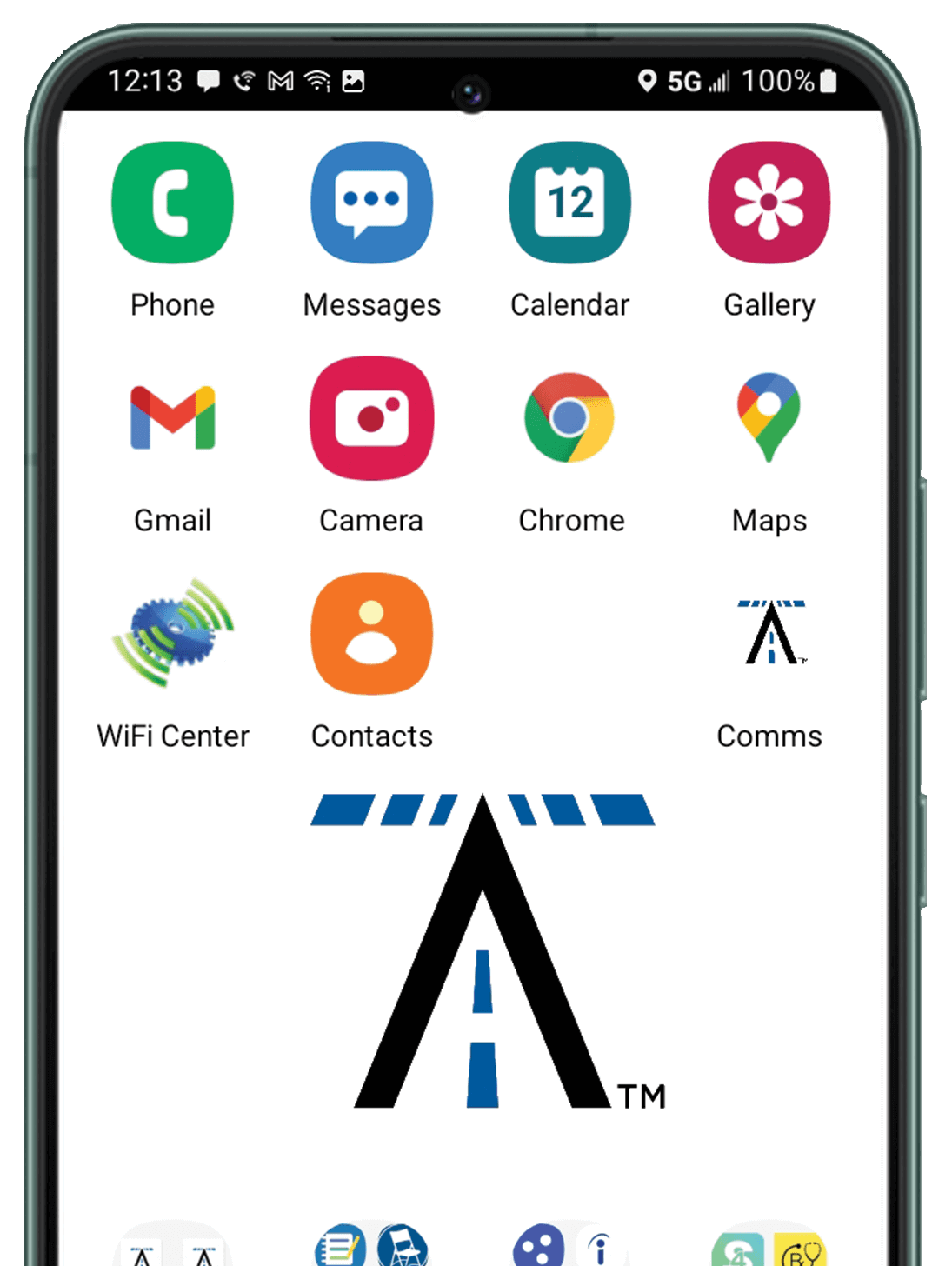
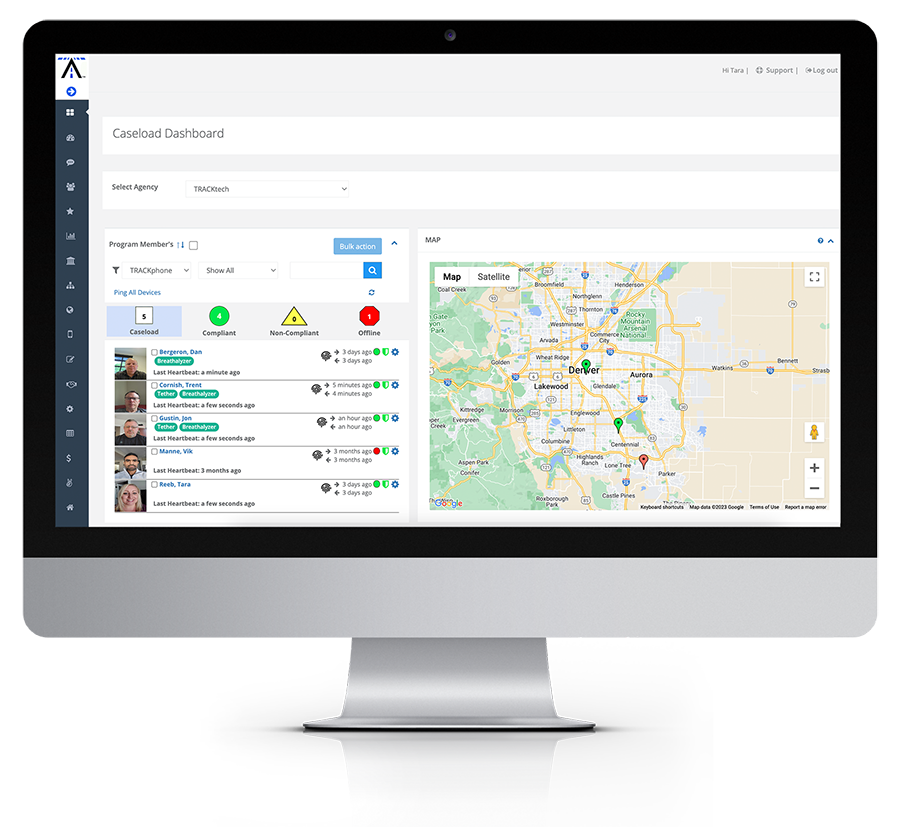
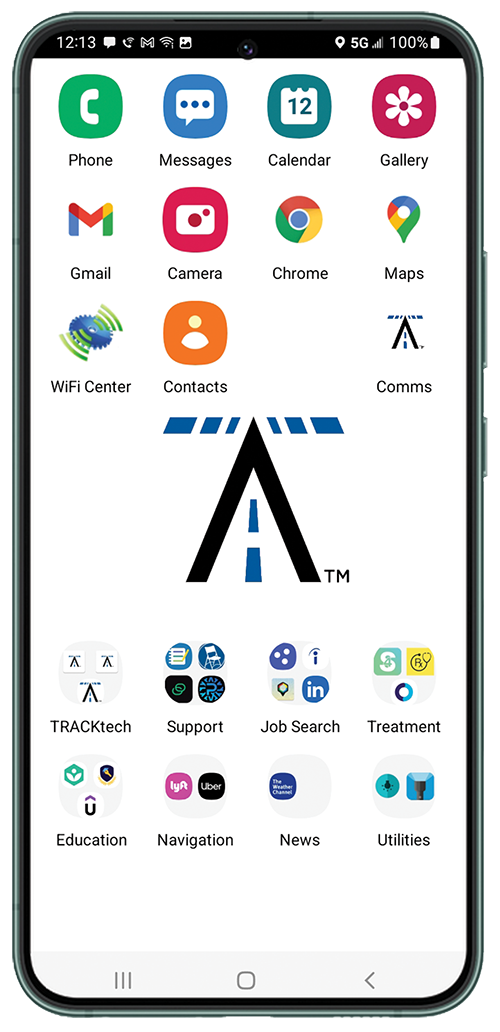
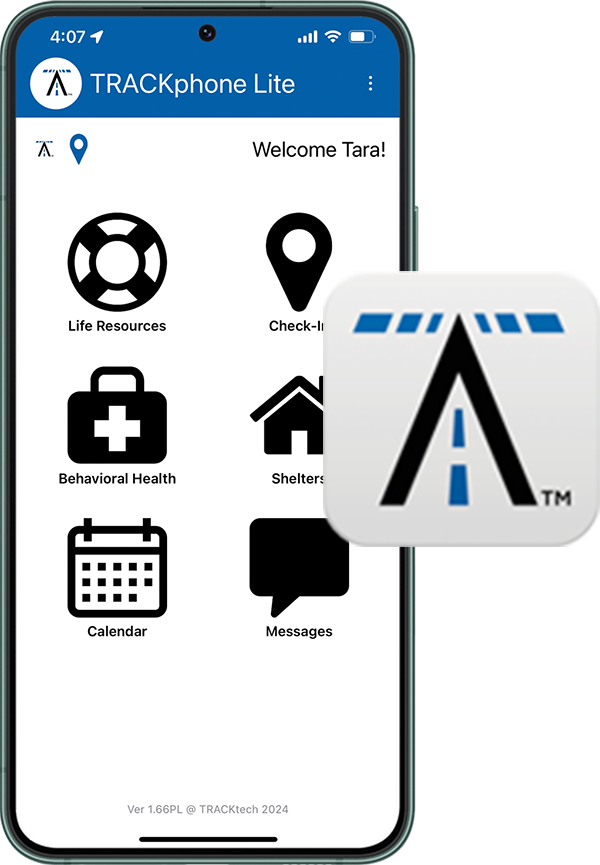
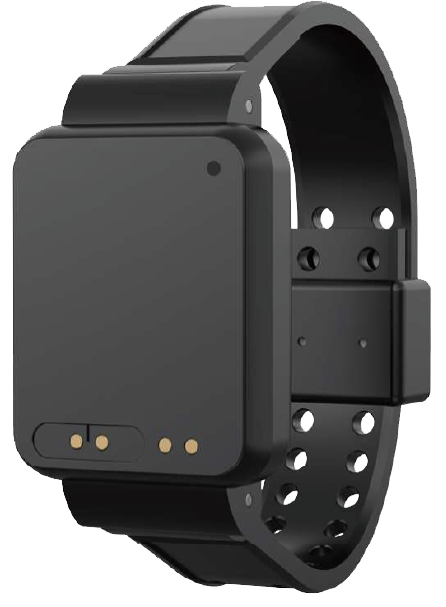
TRACKcase™ provides officers with a web-based case management system that centralizes supervision data and automates workflows across an entire caseload. TRACKphone™ delivers smartphone GPS monitoring for probation, biometric identity verification, secure messaging, and video conferencing in one agency-managed device. TRACKtether™ is a wrist worn bracelet that adds wearable proximity monitoring with tamper detection and indoor or outdoor tracking capabilities. These tools work together to reduce administrative friction, so officers spend less time switching between systems and more time applying professional judgment and allow officers to apply the risk principle as to the level of monitoring (e.g. with or without a tether and the number of biometric checkins).
Agencies must balance efficiency with security. Integration with existing infrastructure minimizes disruption during implementation.
Departments that modernize their monitoring approach often report measurable improvements:
When officers reclaim hours previously consumed by low-level alerts, they strengthen supervision quality. They focus on individuals who require intensive support, address substance use relapse earlier, and intervene before instability escalates. Compliance improves because expectations become clearer and feedback becomes immediate.
Probation departments face growing caseloads, tight budgets, and increased accountability from courts and communities. Small operational improvements compound quickly across large caseloads.
Reducing unnecessary technical violations improves metrics while restoring time to officers, preserving court resources, and supporting individuals working toward stability and lowering their risk of recidivism..
If your agency wants to evaluate how integrated monitoring and case management technology could reduce workload and strengthen supervision outcomes, download the free “Impact Report: Modernizing Probation Monitoring" that outlines practical implementation strategies, measurable performance indicators, and examples of how agencies are reducing administrative burden while reinforcing accountability.
TRACKtech helps supervision teams to include both officers and management teams move beyond reactive alert management and into smarter, more efficient case oversight. Instead of juggling disconnected tools and reviewing hundreds of low-risk notifications, officers gain a unified platform designed to reduce administrative friction while strengthening accountability.
With integrated solutions like TRACKcase™, TRACKphone™, and TRACKtether™, agencies can centralize supervision data, enable real-time client self-correction, and automate routine workflows that typically consume valuable staff hours. The result is fewer unnecessary technical violations, faster insight into meaningful risk, and more time for officers to focus on behavioral change and public safety priorities. Furthermore, there are integrated “add-on” solutions, such as remote drug and alcohol testing, that will only enhance supervision efficiencies.
For departments facing rising caseloads and increasing scrutiny, TRACKtech delivers a practical path forward by combining modern monitoring technology, secure communication, and data-driven visibility in one cohesive ecosystem built specifically for community supervision.


TRACKtech LLC
6295 Greenwood Plaza Blvd, Ste 100
Greenwood Village, CO 80011